
I have written previously about social engineering in financial crime, identity scams and the rise of deepfakes. Those threats are serious, technically fascinating and strategically important. But at the recent FinTrail Conference FFECON26, listening to cybercrime investigator Paul Raffile speak about financial sextortion was different. This is a topic I had not covered before. And it was deeply troubling to hear.
Financial sextortion has become the fastest-growing cybercrime targeting young people. Reported cases in the United States alone rose from 139 in 2021 to 36,000 in 2024, with 2025 already exceeding 55,000. At least 60 teenagers have died by suicide as a direct result since late 2021. These numbers represent lives ended within hours of first contact. For those of us working at the intersection of financial crime, technology and regulation, this issue demands attention not only as a safeguarding concern, but as a question of financial resilience and systemic stability.


A Rapid Psychological Attack with Financial Consequences
The mechanics are brutally efficient. A teenage boy, most often aged 14 to 17, is contacted on Instagram or Snapchat by someone posing as a girl. Mutual friends make the profile look credible. The conversation begins casually but quickly becomes flirtatious. Within a short space of time, an intimate image is sent to the boy, with encouragement or pressure to respond in kind. The conversation escalates quickly, and an image is exchanged.
The tone changes abruptly, and the friendly exchange turns into a stream of threats. The person behind the account reveals their true intention and demands money, warning that the image will be sent to parents, classmates, teachers or sports teammates if payment is not made immediately. Screenshots of the victim’s follower list are often used as proof that the threat can be carried out. In a particularly cruel escalation tactic, the criminals may then contact the teenager again from a different phone number or account, this time pretending to be a police officer or law enforcement official. They accuse the victim of having shared explicit images with an underage girl and threaten arrest, criminal charges or school expulsion.
Under this intense and sustained pressure, many victims pay immediately. The sums demanded are often relatively small – £50, £100 or a few hundred dollars. These amounts may not raise alarms within financial monitoring systems, as transaction filters treat these payments as ordinary. To a teenager, however, that money may represent everything they have. When the first payment is made, the demands rarely stop. Criminals claim additional fees are required to delete the image, remove it from “backup folders”, or prevent further distribution. Despite the severity of the threats, the images are rarely shared. Fewer than 10% of cases result in the distribution of images publicly.
More than 90% of reported victims are boys. We often speak about the vulnerabilities faced by girls online, and rightly so. Yet this crime exposes a different weak point. Teenage boys are frequently less socially conditioned to detect sexualised manipulation.
Organised Networks in a Complex, Interconnected System
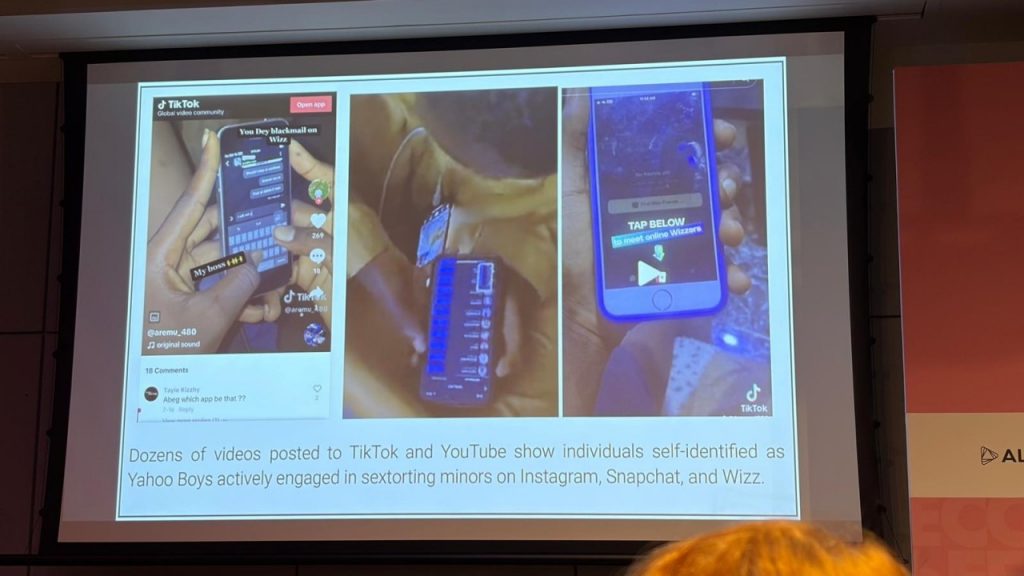
Raffile’s investigation identified repeated scripts, identical phrasing and organised recruitment through loosely connected cybercriminal subcultures, often referred to as “Yahoo Boys”. On social platforms, recruitment videos and blackmail tutorials have gathered millions of views before removal.
What we are witnessing is an adaptive, decentralised criminal ecosystem operating across borders and across platforms. This is where the issue connects directly to the UKFin+ agenda on Financial Resilience & Stability.
Financial markets and the technologies that support them are complex, open and evolving systems of interacting agents. Minor disturbances can propagate rapidly through interconnected networks. What appears to be a small individual payment can form part of a much larger, distributed criminal model.
Financial sextortion operates precisely within this complexity. It exploits:
- Social media architectures
- Peer-to-peer payment systems
- Youth access to digital financial tools
- Cross-border money movement
- Psychological pressure as leverage
From a systems perspective, this is a feedback-driven phenomenon. Payment platforms introduce teen accounts; criminals adjust tactics. Social media platforms modify privacy controls; attackers pivot. Enforcement pressure increases in one geography; activity disperses to another.
Academics in the UKFin+ Network recognise that simplistic, overconfident models are inadequate in complex financial ecosystems. Addressing sextortion requires a multidisciplinary lens that integrates economics, behavioural psychology, criminology, data science, and financial modelling. If resilience means preventing contagion of risk across interconnected actors, then we must treat this crime as part of the broader stability question.
Financial Resilience Beyond Markets: The Human Layer
Financial resilience is often discussed in relation to market shocks, crypto asset volatility or systemic liquidity risk. The UKFin+ research agenda highlights the need to measure, monitor and control systemic risk posed by emerging asset classes and technologies. It emphasises that financial crime law and enforcement must be supported by high-tech automated detection and forensic tracing systems. Financial sextortion sits squarely within that remit.
The payments involved may be small, but at scale, they represent a distributed extraction model that moves funds across jurisdictions. More importantly, the psychological impact on young victims creates a secondary social shock. When 23% of teenagers report having been targeted or victimised, the issue is no longer peripheral. It becomes a generational resilience concern.
There is also a long-term systemic dimension. If a significant proportion of today’s teenagers experience blackmail or coercion, what does that mean for future public trust? For the integrity of future professionals in financial services or public institutions? Blackmail material does not expire. Financial stability depends not only on liquidity ratios and collateral frameworks, but also on trust in institutions, platforms and systems. Where trust erodes, resilience weakens.
Conclusion: Organised Crime Requires Organised Resilience
Financial sextortion is easy to dismiss as a social media problem. However, it operates through financial rails, exploits digital financial inclusion tools and scales through interconnected networks.
UKFin+ was established to address complex, persistent challenges in financial services through collaborative research. The resilience agenda acknowledges that modern financial systems are adaptive, interconnected and vulnerable to non-linear shocks. This issue reflects that complexity. A seemingly minor disturbance, such as a small peer-to-peer transfer, can cascade into personal tragedy. If we are serious about financial resilience and stability, our research, regulation and technological responses must be equally so.