
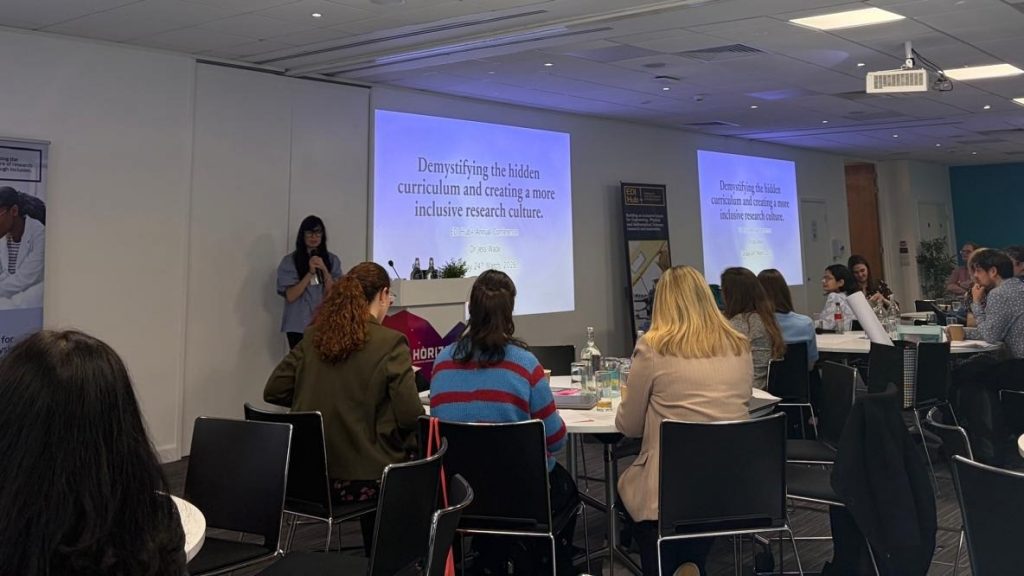
Walking into the EDI Hub Annual Conference in Leeds on 24th March, representing UKFin+ Network, I felt that familiar mix of curiosity and anticipation. EDI events often bring together passionate people, but this one felt different before it even began. The room was alive with colour, energy, and openness, reflecting exactly what the day was designed for: a collective re‑imagining of what an inclusive research system could look like. What unfolded was a powerful story about evidence, courage, cultural change, and a future that can only be built together.
A Community Ready to Move Beyond Good Intentions
From the opening remarks, the tone was set. The EDI Hub team spoke frankly about a challenge many of us recognise: the UK research landscape has no shortage of innovative EDI initiatives, but too many remain isolated when brilliant pilots struggle to embed, scale, or survive their first funding cycle.
The Hub’s mission aims to change that narrative. Drawing inspiration from technology readiness levels, they introduced EDI Intervention Readiness Levels. It’s a tool designed to help organisations understand not only what works, but what is ready to be scaled. Alongside this sits a curated national resource centre already housing more than 90 evaluated EDI practices built to support real, evidence‑based decision making.
The message was unmistakable: We’ve spent years sharing EDI ideas. Now we need to embed them.
Evidence Over Assumption: A Shift in Funders’ Mindsets
One of the day’s standout moments was the keynote by Professor Charlotte Deane, Executive Chair of EPSRC. With humour, honesty, and scientific clarity, she walked us through what happens when a funder decides not just to care about EDI, but to analyse itself with the same rigour as any research project.
The results uncovered myths, challenged assumptions, and, in some cases, surprised even seasoned insiders. For example:
- Highly cited, but untested beliefs about the influence of university prestige did not hold up in the data.
- Panel composition made a measurable difference, with simply having women present improving outcomes for women applicants.
- Intersectional analysis revealed subtle but persistent biases invisible in surface‑level statistics.
Her framing was simple and profound:
“We talk about excellence, but excellence cannot come from a narrow slice of society. It requires the widest possible range of perspectives, experiences and talents.”
What struck me most was her firm belief that EDI should eventually become a natural part of our processes, expectations, and culture so ingrained that a conference wouldn’t be needed to remind us of its importance. However, she also pointed out that we have not yet reached that point.
The Hidden Curriculum: Barriers Too Often Unseen
Throughout the day, another theme emerged repeatedly: the hidden curriculum of academia, those unwritten rules, informal networks, cultural norms, and tacit expectations that quietly shape who progresses and who leaves.
Researchers spoke candidly about:
- Neurodivergent postgraduate students navigating unclear, inconsistent “reasonable adjustment” systems.
- Supervisors doing their best, but lacking the confidence or guidance to support students with diverse needs.
- Staff from underrepresented groups shouldering the “service tax”, the invisible labour of pastoral care, outreach, and EDI work that keeps institutions running, but rarely counts in promotions.
- Postdocs and PGRs who were brave enough to report unsafe or discriminatory behaviour, only to find the structural incentives protecting the very people causing harm.
These stories, shared with honesty and vulnerability, showed that culture and not capability is the barrier many people face. And yet, throughout these conversations, there was also hope. Because naming these hidden barriers is the first step to dismantling them.
Inclusion Through Design: Interventions That Change Lives
The lightning talks provided a window into the extraordinary EDI work happening in pockets across the country. We heard about:
- Roving Researcher schemes that provide skilled research cover during parental or long‑term leave, transforming careers and proving that inclusivity can be cost‑neutral and scientifically productive.
- Neurodiversity training and microaggression modules co-created with staff and students, ensuring training genuinely reflects lived realities.
- PhD Your Way / Research Your Way, tackling the information inequality that often locks people out of research careers before they even begin.
- The Herschel Programme aims at uplifting women in technical leadership, an often invisible but essential part of research culture.
- LGBTQ+ inclusion research revealing that symbols only matter when actions do; a timely reminder that authenticity, not performance, builds trust.
They were practical interventions producing tangible impact, often run by small teams with extraordinary commitment. If properly supported and scaled, several could reshape the research ecosystem altogether.
Inclusion as Collective Responsibility
A recurring insight throughout the conference was this: EDI is not the job of the underrepresented. The burden cannot continue falling on the same students, staff and early‑career researchers, the people with the least institutional power, and the most to lose. Cultural change requires leadership signals, structural accountability, and shared responsibility.
As one speaker put it: “Nobody is irreplaceable. But everyone deserves to feel that they belong.”
A Warning From Elsewhere: Progress Is Not Guaranteed
A compelling thread through the day, sometimes subtle, sometimes explicit, was the fragility of EDI progress. Recent international examples, particularly from the US, illustrate how quickly political shifts can undermine years of work. Programmes, policies, fellowships and equity offices vanished overnight.
The lesson for the UK: Embedding inclusion into governance, policy, evaluation frameworks and leadership strategies is our best protection against regression.
We cannot assume good intent will always prevail. Our systems must make inclusion the default, not an optional extra.
Looking Ahead: What We Must Build Together
Leaving the conference, I felt both inspired and grounded. Inspired by the commitment, creativity and courage shown across the community. Grounded by the reminder that transformation is slow work and must be shared work. The future we need will require:
Embedding, not just piloting. EDI practices must live in the everyday operations of our institutions.
Listening, not assuming. Lived experience must guide interventions from the start.
Rewarding, not punishing, inclusive leadership. Promotion and recognition systems must value culture-building.
Transparent, data‑driven systems. We can only change what we are willing to measure.
Sector-wide collaboration, not siloed efforts. Every discipline, institution, funder and network has a role to play.
Courage to speak up, to challenge systems, to imagine a research landscape where everyone can thrive.
Final Thoughts
The EDI Hub Conference was a glimpse into the research culture we could build if we collectively decide to embed inclusion in every corner of UK research and innovation.
Representing UKFin+ Network, I left with a renewed sense of purpose and responsibility. Our commitment now is to bring these insights back into our own work to champion evidence, amplify lived experience, and help shape the systems that will define the next generation of researchers.