
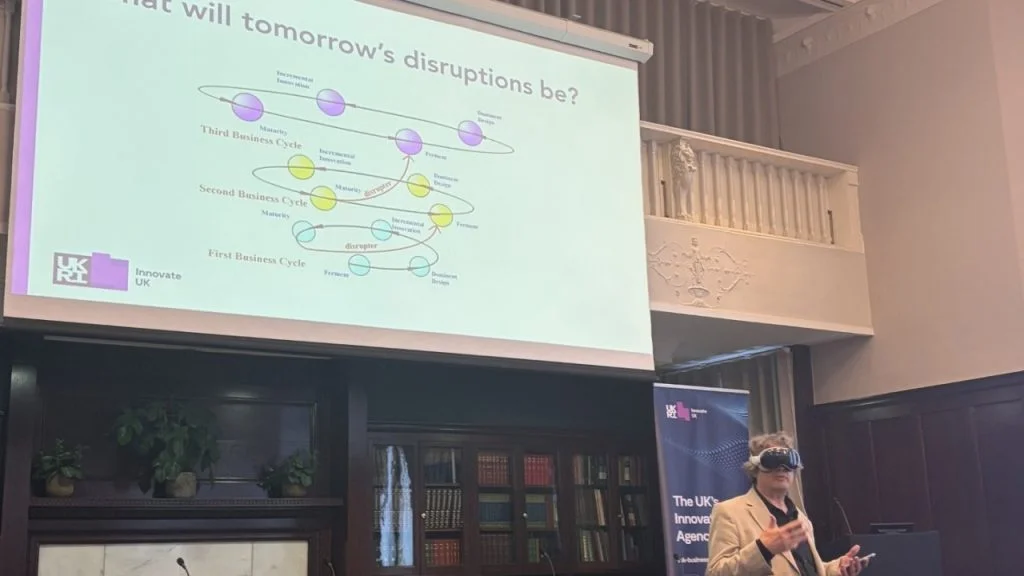
With so much uncertainty defining today’s world, Innovate UK’s “Glimpse of the Future” event offered a rare space to step back and think beyond the immediate challenges. This event brought together leaders, innovators and curious minds to explore how emerging technologies might shape the next two decades. Rather than telling us what the future will look like, they encouraged us to think openly, question boldly and understand the future through the lens of our own professional and human experiences.
What Happens When Disruption Becomes the Norm
During the session, we were taken on a fast-paced tour through some of the most disruptive technologies shaping the world today. The speaker Jonathan Mitchener – Futurist at Innovate UK, made it clear from the outset that his role was “to provoke, not to predict,” and he delivered exactly that. From the evolution of the online world and the rise of agentic AI to wearable computing, robotics and emerging breakthroughs in biotechnology, he painted a vivid picture of how quickly the boundaries of the possible are shifting. What was striking apart from the technologies themselves was how he presented their influence: as a series of perfect storms where innovations come together to transform business models, behaviours, and even our perception of what it means to be human. His examples from augmented-reality headsets used as everyday computers to autonomous chemistry labs accelerating R&D showed how deeply these shifts are already embedding themselves into daily life. And while some aspects felt exciting and others slightly unsettling, the session succeeded in its purpose: opening our minds to futures we may not normally stop to imagine, and encouraging honest conversation about the ethical, social and personal decisions that lie ahead.
Will AI replace us or redefine us in 20 years’ Time?
Our table discussions quickly moved into one of the biggest and most controversial questions of our time: whether AI and robotics will eventually replace humans, and how we might recognise if that moment is approaching. Some participants felt confident that practical resource constraints would keep humans relevant for longer than we fear; after all, producing, powering and deploying advanced robotics still relies on human-controlled systems. Others argued that even resource limitations won’t slow down the possibility of machines overtaking us in capability, scale and efficiency.
For me, the honest answer is that nobody truly knows and perhaps that uncertainty is the only certainty we have. Throughout history, predictions about technology have often missed the mark. People once believed that by now we would be holidaying on Mars and commuting in flying cars. Instead, technology advanced along very different paths, driven by rapid development cycles, increasing economic competition, and the more recent acceleration linked to global tensions and commercial ambition. The pace at which new tools emerge today makes long-term forecasting more challenging than ever, which is exactly why conversations like this are so valuable.
What Happens to Young Talent When Junior Roles Disappear?
Another topic that sparked deep reflection was the future of young people entering the workforce. As AI takes on more entry-level tasks, many organisations are quietly phasing out junior roles. This raises a difficult but necessary question: if fewer people can start at the bottom, how will anyone gain the experience needed to rise to senior positions? Expectations for graduates may shift dramatically, and the path to expertise may look very different in the future.
Despite these concerns, I don’t believe most jobs will disappear entirely; rather, the skills required for them will evolve. Even though we see increasing demand for engineering, computing and data-focused roles, other professions will continue to exist, just shaped by new expectations and new tools. Some researchers argue that heavy reliance on AI could limit human cognitive development, while others believe automating repetitive tasks frees us to grow in new ways. Both perspectives have merit. What becomes clear is that we need an education system agile enough to adapt, ensuring that the talent being developed aligns with the needs of society. Many careers that are now well established, such as drone operation, sustainability leadership or AI psychology, barely existed a decade ago. This should give us confidence that as some roles fade, entirely new ones will emerge to take their place.
Finally…
What stayed with me most from the event was not a single prediction or scenario, but the reminder that the future is shaped as much by mindset as by technology. The willingness to stay curious, to lean into discomfort and to entertain possibilities that may feel far-fetched is becoming one of the most important professional skills of our time.
If the session revealed anything, it’s that human beings still hold a unique advantage: we are exceptionally good at imagining, debating and disagreeing about what the future might look like. And ironically, that messy, unpredictable, wonderfully human trait may be exactly what keeps us relevant, no matter how intelligent our machines become.