
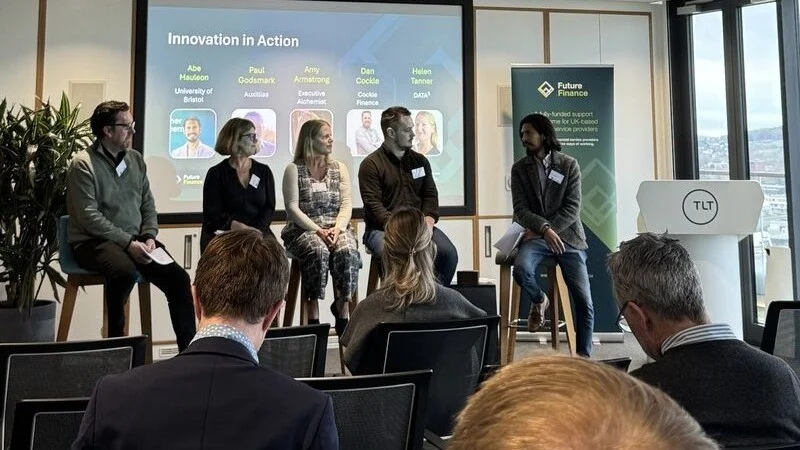
Reflecting on an inspiring day in Bristol, 27 November
Last week, I joined financial services leaders, innovators, academics, and partners in Bristol for the Future Finance Finale: Innovation in Action & What’s Next. It was a half-day celebration of what the programme has achieved and a bold look at where innovation adoption in financial services is heading next.
The day opened with reminders of why Future Finance matters to industry and to society. The programme was born from UKRI funding to address systemic barriers to innovation adoption across financial services in technology, leadership, culture, inclusion and access. Built on social science research and co-produced with partners across four universities, FinTech West, and community organisations, the accelerator explored how innovation can support underserved and underrepresented groups, from unbanked households to women entrepreneurs and minority communities. This framing set the tone for an event that was as much about societal impact as it was about commercial transformation.
A Journey of Identity, Experimentation, and Impact
Jack opened the afternoon with a look back on how Future Finance began, when the team wasn’t quite sure what shape it would take. Was it an accelerator? A consultancy? A research project? A digital adoption programme? Ultimately, Future Finance became something unique: an Innovation Adoption Accelerator grounded in research and tested in the real world.
This research was experimentation, iteration, and learning what actually works for financial services firms striving to innovate. Future Finance used its funding window to test, refine, and streamline practical tools for adoption: design thinking, horizon scanning, innovation leadership, and collaborative challenges. These have now formed a coherent, evidence-backed model that is ready to transition into commercial delivery.
Fear, Uncertainty and Doubt and the Confidence to Break Through It
Keynote by Anna-Lisa from Sapphire & Steel explored the emotional and organisational dynamics that prevent innovation from taking root. Through both corporate and start-up experience, she found the same pattern repeating: The biggest barriers were not cost or regulation, but FUD factor – fear, uncertainty and doubt.
Her team’s early research for Future Finance confirmed this across the financial ecosystem. Change stalls not because solutions don’t exist, but because stakeholders fear risk, question their ability to implement new tools, and doubt whether change will succeed at all.
The antidote? Confidence built through collaboration, open data, diverse voices, and structured facilitation.
This led to the creation of Future Finance’s collaborative challenge “petri dish” – a neutral space where industry, academia, regulators, and innovators come together to deeply understand problems and co-design low-risk, high-learning first steps. Across the challenges, the approach consistently unlocked new insights, aligned stakeholders, and created shared next actions.
Moneyhub: Why Smart Data Is the Next Great Leap
The speaker Dan Scholey from Bristol-based fintech company Moneyhub discusses the power of open banking, smart data, and AI by framing innovation through the story of Brunel and his ambitious London-to-New-York vision. The analogy illustrates how innovation requires overcoming obstacles, securing funding, adapting to regulation, and building minimum viable (or “minimum lovable”) products while still selling the bigger vision. Talk brought innovation back to something very human: the everyday financial pressures that individuals and families face. Through personal stories, Dan showed how managing money can be overwhelming, especially for people who are vulnerable, caring for relatives, or trying to make the right decisions without clear guidance. Moneyhub demonstrated how open banking, and soon, wider smart data, can help people make better choices by giving them safe, consent-based ways to share their financial information and receive personalised support.
He also highlighted AI’s growing role in simplifying complex financial data. Instead of replacing people, AI can clarify language, identify patterns, flag risks, and suggest actions, reducing consumer stress and enabling firms to provide fairer, responsive services. Moneyhub envisions a future where financial decisions are easier, safer, and more transparent for everyone. Their message aligns with the theme: innovation has value when it improves lives and builds trust in the financial system.
The Panel: Culture, People, and the Real Work of Innovation
The panel brought together lenders, consultants, advisers, and innovation partners to reflect on what stops innovation from succeeding—and how Future Finance helped them overcome it. Key themes included:
1. Funding and stigma still block many firms – Small-sum lenders shared how perceptions around high APRs can shut down conversations before they even start.
2. People, not technology, are the hardest part of innovation – Fear of failure, defensive behaviours, competing priorities, and risk-averse cultures slow innovation far more than any technical barrier.
3. Confidence is the critical ingredient – Confidence to try, to fail forward, to challenge assumptions, and to define a manageable first step.
4. AI is accelerating change, but unevenly – Half of employees use it daily; half not at all. This divide is shaping the future of work.
5. The value of Future Finance’s programmes – Participants highlighted how the Leadership Programme offered:
- practical design thinking skills,
- space to experiment,
- cross-sector learning, and
- a powerful new peer community.
Ultimately, the conversation reinforced that innovation is not just a technical exercise, it is a cultural, human, and strategic one. Empowering people, embracing controlled risk, and building confidence are essential to driving meaningful change across the financial sector.
Final Thought
If there’s one thing this event proved, it’s that innovation in financial services isn’t held back by a lack of ideas or technology, but it’s held back by people clutching onto old habits like a favourite worn-out jumper. The real breakthroughs happened when organisations were willing to get uncomfortable, rethink assumptions, and actually talk to each other.
My key takeaway? Financial innovation isn’t about shiny tools or clever acronyms. It’s about confidence to try, to fail forward, and to challenge the “we’ve always done it this way” mindset. And if Future Finance showed us anything, it’s that once you replace fear, uncertainty and doubt with curiosity and collaboration… even the most traditional corners of financial services can surprise you.