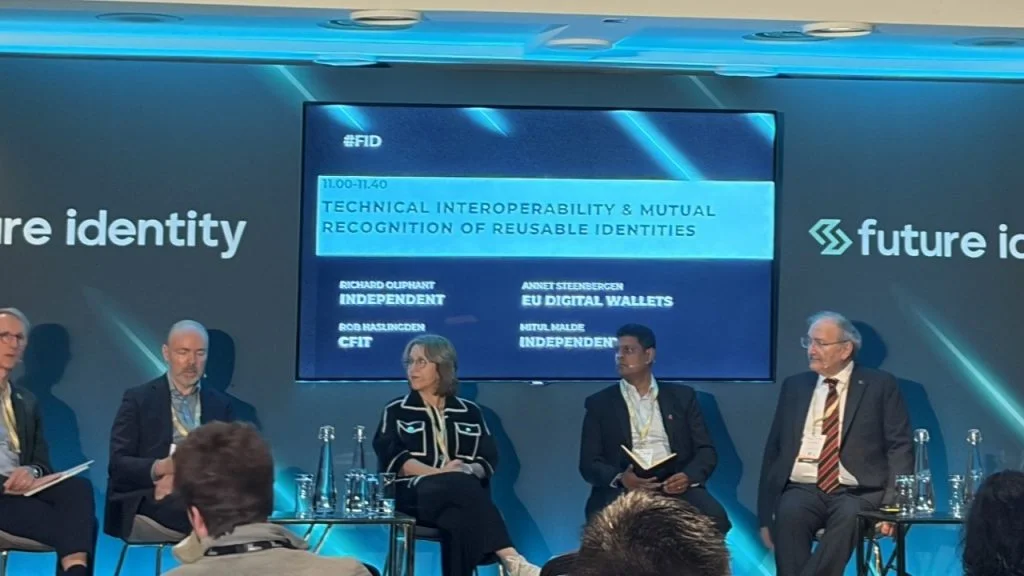
Another brilliant session at the FTT Fintech Festival 2025 focused on a topic that affects almost everything in financial services: digital identity and interoperability. Digital identity used to be a niche or technical topic, now it’s becoming the backbone of onboarding, payments, travel, supply chains, fraud prevention, and even how citizens interact with the state. And as this panel made clear, the decisions we make now will shape how competitive and connected the UK will be in the next decade.
The UK’s Two-System Challenge.
As it stands, the UK has two parallel identity systems: the government’s One Login for public services and the private sector’s DIATF framework, which certifies around 40 identity providers. Both are capable and secure, but they currently operate in silos. Citizens often don’t know which system to rely on for a particular purpose, and this uncertainty has slowed adoption. Legislation hasn’t helped either. The government previously announced that digital age verification for buying alcohol would be implemented by the end of 2025, but the required legislation never made it through Parliament. For identity providers who have invested heavily in preparing for mainstream use cases, this delay has understandably dented confidence.
Meanwhile, Europe Is Moving at Pace.
In contrast, the European Union has already enshrined the EU Digital Identity Wallet (EUDIW) in law. Every EU member state must be able to issue a digital wallet by December 2026. And Europe’s vision goes far beyond a simple identity token. Their wallet will eventually store everything from travel credentials, business mandates, supply-chain documentation and academic qualifications to bank account permissions, all anchored in government-verified data. Large-scale pilots are already underway across the EU, involving tax authorities, chambers of commerce, airlines, payment providers and universities. The ambition and coordination are hard to ignore, especially when compared to the UK’s slower and more fragmented approach.
The Good News: Technical Alignment Is Possible
Despite Brexit, the panellists were remarkably optimistic about the prospects of UK–EU interoperability. Both sides are using similar standards, from passport and driver licence formats to W3C Verifiable Credentials and privacy-by-design protocols. Selective disclosure technology, which allows you to prove you’re over 18 without revealing your actual age, is also being adopted on both sides. In other words, the technological foundations already exist. There is nothing inherent in the UK architecture that prevents compatibility with European identity systems. The real obstacle is political rather than technical.
The Missing Link: Political Will
One of the more sobering insights from the panel was that the UK does not currently feature on the EU’s priority list for digital identity mutual recognition agreements. Until this changes, UK citizens won’t enjoy the same seamless experiences that Europeans will soon take for granted – opening a bank account abroad in an hour instead of months, accessing cross-border government services, hiring a car or proving a business mandate with a tap. Without a mutual recognition agreement, the UK risks becoming a digital island. And in a world where fraud and financial crime move freely across borders, that isolation comes at a cost.
The Economic Case Is Undeniable
Beneath the legal and regulatory complexity lies a straightforward truth: interoperable identity systems generate significant economic value. Faster onboarding, smoother cross-border trade, reduced administrative costs for SMEs, improved AML/KYC compliance and the ability to verify goods in transit become significantly easier when identity is trusted across borders. The panel highlighted that identity isn’t just about proving who you are, but also enabling trust between organisations, unlocking new products, and reducing the friction that currently slows down international business.
And Then There’s Fraud…
Fraud is increasingly sophisticated, industrialised and global. Criminals collaborate seamlessly across jurisdictions. When identity systems diverge, the resulting gaps become opportunities for exploitation. Interoperable identity is a critical fraud prevention tool. Consolidated standards, shared verification protocols and aligned assurance levels make it harder for criminals to exploit inconsistencies between countries.
Priority Academic Research Themes Emerging from the Panel
The FTT discussion highlighted the profound interconnection between digital identity and legal frameworks, economics, fraud prevention, behavioural trust, and cross-border data flows. To support evidence-based innovation, UKFin+ can help catalyse research across the following five advanced themes:
1. Cross-Border Trust Architecture for Digital Identity. Research how trust, assurance levels, credential standards, and regulatory models can be aligned across jurisdictions with different legal traditions. This includes exploring model-law approaches (e.g., UNCITRAL), interoperability layers, and governance structures that allow identity systems to interoperate securely without requiring identical political frameworks.
2. Economic Impact of Identity Interoperability. Develop rigorous models that quantify the impact of interoperable identity on key economic indicators, including onboarding efficiency, SME financing, supply-chain verification, AML/KYC costs, and fraud rates. This work could underpin a Digital Identity Economic Impact Index, providing policymakers and industry with measurable evidence.
3. Privacy-Enhancing Verification Technologies. Advance research into privacy-preserving identity mechanisms, including zero-knowledge proofs, decentralised attribute management, selective disclosure, and cryptographic consent models. This work should examine how high-assurance identity can coexist with minimal data exposure and strong user autonomy.
4. Identity-Driven Fraud Intelligence and Prevention. Investigate how identity data, assurance levels, and ecosystem interoperability can be utilised to predict, detect, and prevent fraud. Research may include modelling cross-border fraud vectors, defining shared fraud-signal taxonomies, and designing frameworks for secure, privacy-compliant intelligence exchange across sectors and jurisdictions.
5. Behavioural and Sociotechnical Foundations of Identity Adoption. Examine the cultural, psychological, and social factors that drive public acceptance or resistance to digital identity. This includes examining trust formation, digital literacy barriers, differences between common-law and Napoleonic-law identity traditions, and design principles that support the adoption of inclusive, user-centric identities.
Final Thoughts
This session served as a reminder that digital identity is more than just technology. It concerns trust, mobility, economic prospects, and international collaboration. Europe is making progress with a bold, unified strategy. The UK still has the opportunity to align, but only if we recognise the importance of the issue and act now, while cooperation remains possible.
For anyone working at the intersection of fintech, regulation and digital trust, this is a conversation worth paying attention to. More insights from FTT will follow soon as part of this series.
If you’re working in digital identity, onboarding, policy or fraud prevention, I’d love to hear your perspectives.